Shortest Way Home by Pete Buttigieg
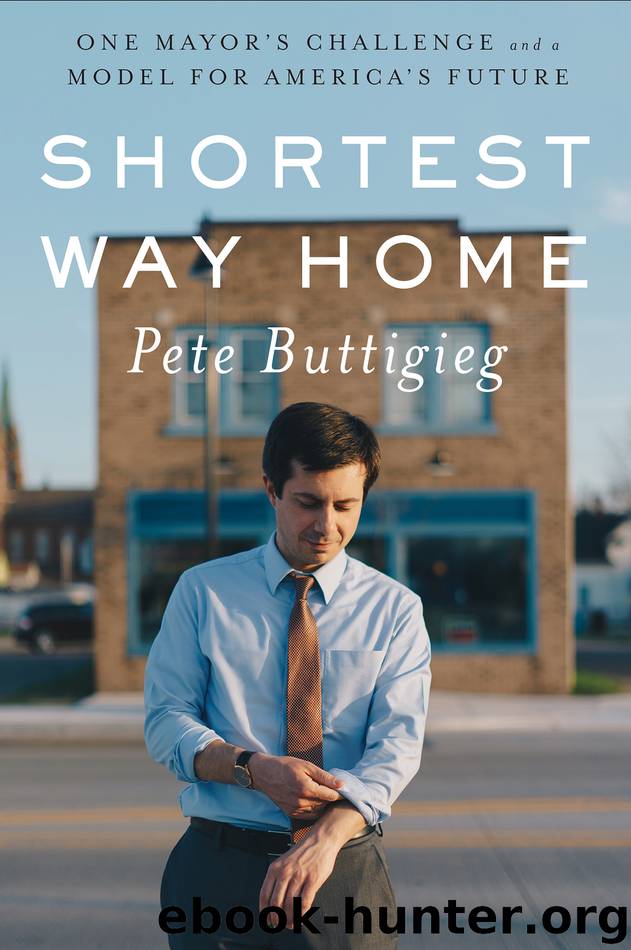
Author:Pete Buttigieg
Language: eng
Format: epub
Publisher: Liveright
Published: 2018-12-04T16:00:00+00:00
SOME UNIVERSITY DEPARTMENTS have fairly obvious inroads to collaborate with their surrounding communities, working in fields like urban planning, civil engineering, or law. But some of the most compelling partnerships grew out of departments that I had never expected would be so well equipped to engage in the life of the city—such as the neuroscience students I met one night while visiting a support group for mostly ex-offenders at a community center on the West Side.
The taco meat was mostly gone by the time I arrived, so I went to take a seat among the twenty or so chairs in a circle. It was a diverse group. One man looked about sixty-five years old, African-American, with jeans and a dark shirt and glasses; another did not look like he could be eighteen yet, a slim Latino kid in a gray sweatshirt with jeans and white shoes, with tattoos from the side of his neck to the tops of his hands. One woman stared straight ahead of her, talking to no one, while others made small talk with the people next to them. The only people who looked altogether out of place, besides me, perhaps, were four sunny Notre Dame undergraduates, huddling over laptops and trying to make a projector work. In addition to the usual support conversation, the evening would feature a presentation about their field, which turned out to be neuroscience. In particular, they explained, they wanted to talk to the group about neuroplasticity.
I’m about as generous-minded toward undergraduates as it gets, but I suspect my face revealed my inner thoughts at that moment, something like: Please tell me you know what you’re doing here. Were these mostly white kids really going to inflict a PowerPoint about the finer points of neurological research on a room full of reintegrating ex-offenders who were just trying to get their lives back together?
The projector wasn’t working, so three of them held laptops up while another took turns talking. The slideshow explained the development of neurons in adolescence, the electrical and chemical basis of neurotransmission, the relationship of the amygdala to other parts of the brain. They had made it fairly accessible, but it was hard at first to tell if the silent faces of their audience were showing any interest. The students talked about self-control, describing the famous study in which children capable of resisting eating a marshmallow in front of them would earn two later on—and those kids would, it turns out, go on to earn higher incomes and have generally more successful lives. They talked about Buddhist monks’ ability through meditation to activate different parts of their existing neural networks, and the relationship between what you eat and how your brain works. Then the questions began.
“So, you’re saying the neurons I have today are the same as the ones I had when I was a kid?”
“Yes, but they branch off and form new connections, too, and this can keep developing even in adulthood.”
Another asked: “You said that a traumatic event changes your brain.
Download
This site does not store any files on its server. We only index and link to content provided by other sites. Please contact the content providers to delete copyright contents if any and email us, we'll remove relevant links or contents immediately.
| Military | Political |
| Presidents & Heads of State | Religious |
| Rich & Famous | Royalty |
| Social Activists |
Waking Up in Heaven: A True Story of Brokenness, Heaven, and Life Again by McVea Crystal & Tresniowski Alex(37815)
Empire of the Sikhs by Patwant Singh(23090)
We're Going to Need More Wine by Gabrielle Union(19053)
Hans Sturm: A Soldier's Odyssey on the Eastern Front by Gordon Williamson(18596)
Leonardo da Vinci by Walter Isaacson(13341)
The Radium Girls by Kate Moore(12036)
Tools of Titans by Timothy Ferriss(8403)
Educated by Tara Westover(8060)
How to Be a Bawse: A Guide to Conquering Life by Lilly Singh(7494)
Permanent Record by Edward Snowden(5852)
The Last Black Unicorn by Tiffany Haddish(5643)
The Rise and Fall of Senator Joe McCarthy by James Cross Giblin(5284)
Promise Me, Dad by Joe Biden(5157)
The Wind in My Hair by Masih Alinejad(5103)
A Higher Loyalty: Truth, Lies, and Leadership by James Comey(4967)
The Crown by Robert Lacey(4820)
The Iron Duke by The Iron Duke(4367)
Joan of Arc by Mary Gordon(4117)
Stalin by Stephen Kotkin(3973)
